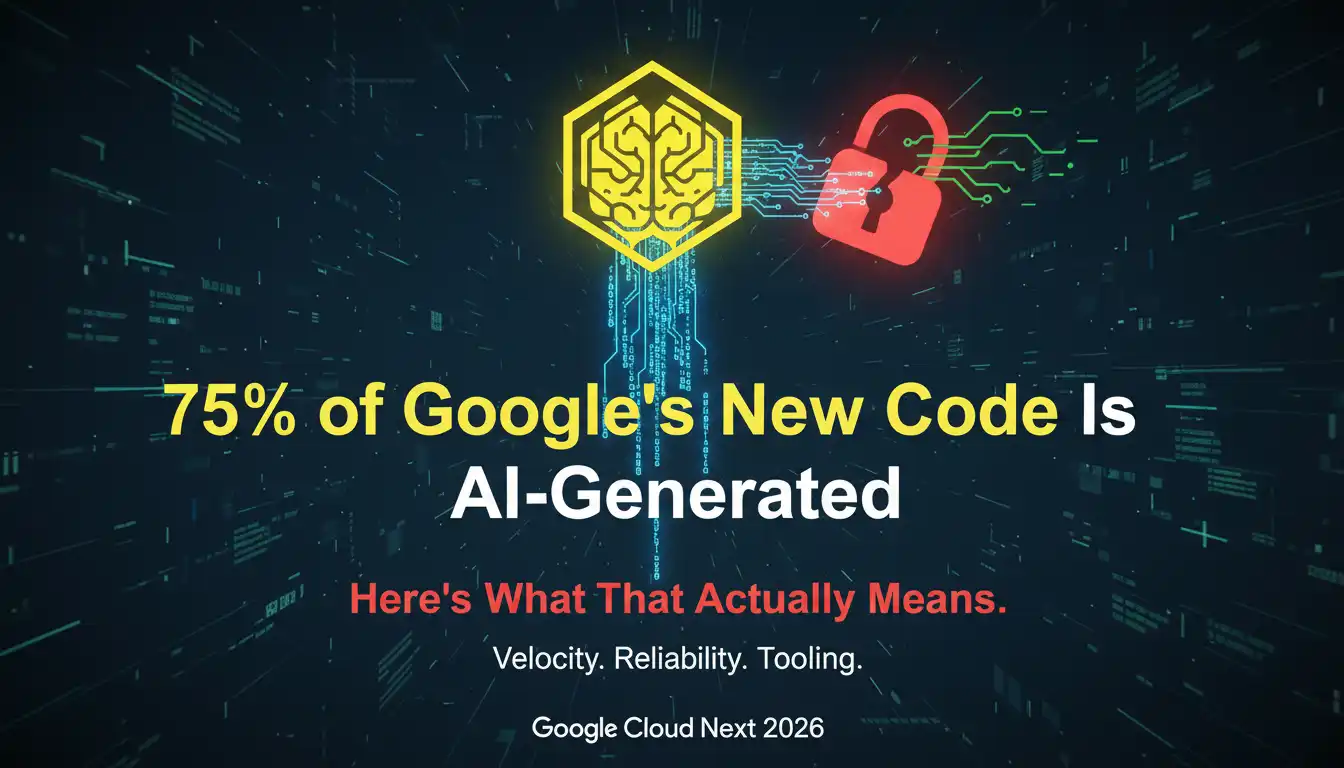
At Google Cloud Next in April 2026, Sundar Pichai disclosed that three out of every four lines of new code Google ships are now generated by AI — and reviewed by engineers before deployment. He framed this not as a threat to engineering headcount, but as an expansion of what a single engineer can ship.
The number is striking. But the more important question is what it tells you about the direction software development is moving — and whether your engineering team's tooling is ready for it.
1The Trajectory Is the Real Story
The 75% figure is attention-grabbing, but the velocity of change is what should make you stop and think.
In October 2024, Pichai cited 25% AI-generated code at Google. By April 2025, it had climbed to roughly 30%. By fall 2025, it crossed 50%. Now it sits at 75% — a tripling in about 18 months.
That is not a gradual transition. That is a step function. A team of 1,000 engineers at Google has effectively added the output throughput of hundreds more without adding headcount. And Pichai's stated plan is to hire more engineers as a result — not fewer — because higher throughput expands what's possible on the roadmap.
There is one number Pichai did not share: how often the AI-generated code gets rejected or substantially rewritten before approval. Without that rejection rate, you cannot fully assess the quality picture. An 80% rejection rate on AI output that still saves time is very different from a 5% rejection rate. Google hasn't disclosed that figure, and it matters.
2What Engineers Actually Do Now
The framing Pichai used at Cloud Next was "agentic workflows" — a structure where AI is the default producer of output and engineers become reviewers, orchestrators, and governors.
That word choice is precise. Three distinct roles are emerging for engineers in AI-native development environments:
- ✓Reviewer — Engineers read AI-generated code, check it against intent, evaluate edge cases, and approve or reject. This requires deep domain knowledge — arguably more than writing code from scratch — because you need to understand what correct output looks like before you can spot where the AI cut a corner.
- ✓Orchestrator — Engineers define the task, scope the constraints, and compose the workflow — deciding which AI tools, which context windows, which validation steps. They are running the process, not executing each step manually.
- ✓Governor — Engineers own the acceptance criteria: what schema the output must conform to, what validation gates it must pass before touching production data. The AI generates. The engineer sets and enforces the bar.
This last role — governance — is where the work gets technical in ways that are easy to underestimate.
3Why Infrastructure Reliability Matters More When AI Writes Code
Here is a counterintuitive implication of the 75% figure: when AI is generating code at scale, the quality of your underlying tooling becomes more critical, not less.
When code is generated by human engineers writing deliberately, each integration point carries implicit human context. The engineer who writes the CSV parser also knows about the edge case from the customer support ticket last quarter. They add a comment. They handle the encoding fallback.
AI-generated code does not carry that organizational memory. It generates against the schema and the prompt you give it — nothing more. Which means your schema has to be unambiguous. Your validation layer has to be explicit. Your data contracts have to be complete.
If an AI agent is generating import logic for your SaaS product — say, a bulk contact upload feature or a product catalog ingestion — and the schema is underspecified, the AI will fill in the gaps with assumptions. Some of those assumptions will be wrong. And when they're wrong in AI-generated code, they're wrong at scale, because the same faulty assumption propagates across every instance the agent produces.
4The Bug Surface Shifts, It Doesn't Shrink
There is a tempting but incorrect conclusion some teams are drawing from the AI code generation trend: that robust data handling infrastructure matters less, because AI can just fix errors at runtime.
The opposite is true. As AI generates more of your integration layer, the data entering your system becomes less predictable, not more. Different AI-generated parsers will make different assumptions about date formats, encoding, delimiter handling, and column name normalization. Without an explicit validation layer, you get a heterogeneous mess of assumptions living inside your codebase — each one generated from a slightly different prompt, each one handling edge cases differently.
The bug surface does not shrink when AI writes more code. It shifts. Instead of logic bugs from human misunderstanding, you get schema assumption bugs from AI under-specified context. These are harder to catch because they often produce valid-looking output that only fails on specific data shapes.
This is exactly why the engineer's governance role matters. And it is why the tools engineers reach for to validate, transform, and enforce contracts on incoming data become load-bearing parts of an AI-augmented stack.
5What This Means for Data Import Flows Specifically
Consider a specific scenario: your SaaS product lets customers import data — contacts, inventory, transactions, anything with structure. That import flow involves column mapping, schema validation, format normalization, and error surfacing.
In a traditional engineering workflow, a developer writes that import handler deliberately. They know the schema, they know what "phone_number" in the source CSV probably means, they write normalization logic for the cases they've seen break before.
In an AI-augmented workflow, that import handler might be scaffolded by an AI agent in minutes. The agent generates something that works for the happy path. But it probably does not handle the customer who exports their CRM with headers like "Tel. (mobile)" instead of "phone", or the one who sends an XML export with BOM-corrupted encoding, or the one whose Excel file uses merged header rows.
The engineer's job in that scenario is not to write the parser — it's to ensure the import pipeline can handle what real customers actually send. That means reaching for infrastructure with explicit AI-assisted mapping, schema enforcement, and edge case handling built in. Not because the AI-generated code is bad, but because the scope of what it doesn't know is larger than what any single engineer would have guessed.
6Agentic Development Needs Agentic Infrastructure
Pichai's characterization of the shift as "agentic" is accurate. AI agents generate code. Engineers govern the output. The loop runs faster than before.
But that loop creates a new dependency: the quality of every integration your AI-generated code touches. An AI agent writing a data import feature will only be as reliable as the import library it's wiring up. A well-designed SDK with explicit schema definitions, good error handling, and documented edge cases gives the AI agent accurate context to generate against. A poorly documented or ambiguous library produces AI-generated code that technically compiles but fails on real data.
This is not a hypothetical. It's a direct consequence of what happens when you increase the volume of generated code without increasing the quality of the interfaces it integrates with.
7The Practical Takeaway for Engineering Teams
If your team is moving toward AI-augmented development — which, at the current pace, is a question of when rather than whether — a few things are worth doing now:
- ✓Tighten your data contracts. Every schema your system accepts should be explicit and machine-readable. Ambiguous schemas produce ambiguous AI-generated parsers. The stricter your schema definitions, the better the AI-generated code that targets them.
- ✓Invest in validation infrastructure. AI-generated code will produce edge cases at scale. You need a validation layer that surfaces them before they reach your database. Row-level error reporting, schema mismatch detection, and type coercion rules need to be explicit — not implicit in the AI's assumptions.
- ✓Choose libraries that work well as AI targets. When an AI agent generates import code, it will pull from the SDK's documentation and type definitions. Libraries with thorough TypeScript types, clear error objects, and well-documented behavior give the AI agent accurate material to generate from. Poorly documented libraries produce plausible-but-wrong output.
This is what Xlork is built for. The React SDK, Node.js SDK, and REST API expose explicit schemas, typed column definitions, and structured validation rules — so whether a human writes the integration code or an AI agent scaffolds it, the contract between the import UI and your backend is unambiguous. AI-powered column mapping handles the translation from what customers actually send to what your schema expects, including the cases no human — and no AI agent — would have anticipated in advance.
💡 Pro tip
AI-generated import code only performs as well as the library it wires up. Try Xlork's free tier to see how explicit schema definitions and AI-assisted column mapping hold up under the kind of unpredictable input your customers actually provide.
8A Note on Where This Is Heading
Pichai's 75% is a milestone for Google — a company with engineering resources that most teams do not have. But the direction is the same for teams of 5 as for teams of 5,000.
More code will be AI-generated. Engineers will spend more time reviewing, orchestrating, and governing. The quality of the infrastructure that code touches will matter more than the quality of the code itself in many cases, because infrastructure is what the AI generates against.
The engineers who do well in that environment will not be the ones who write the most code. They will be the ones who specify the clearest contracts, choose the best-documented tools, and build validation layers that catch what AI assumptions miss. That skill — knowing what your system needs to be explicit about so that AI can fill in the rest reliably — is not going away. If anything, it's becoming more valuable.